
FIFA World Cup 2026 | Round of 32 | NRG Stadium, Houston, Texas | 29 June 2026
Final Score: Brazil 2–1 Japan (HT: 0–1) Goals: Casemiro (56′), Martinelli (90+6′) — Sano (29′)
Gabriel Martinelli came off the bench to score a 96th-minute winner as Brazil survived one of the most nerve-shredding afternoons in their storied World Cup history, beating Japan 2–1 in the Round of 32 at Houston’s NRG Stadium. It was a game that had everything: a shock early lead for the underdogs, a second-half revival from the five-time champions, a breathtaking save off the post, and a last-gasp winner that sent thousands of yellow-shirted fans into delirium while leaving an entire nation heartbroken.
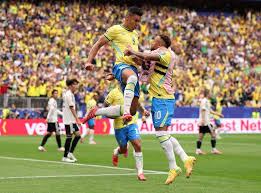
For Japan, it was the cruelest possible ending to a courageous tournament run. For Brazil, it was a reminder that even the most decorated sides in World Cup history can be made to sweat, suffer, and ultimately rely on the brilliance of a substitute to survive.
The Build-Up: Ancelotti Calls for Clarity, Moriyasu Plans the Upset
Going into Monday’s tie, Brazil were the clear favourites. Under Carlo Ancelotti — the most decorated club manager of his generation — the Seleção had topped Group C with an unbeaten campaign, grinding out a draw with Morocco before cruising past Haiti and Scotland with 3–0 victories. Vinicius Jr had been in electric form, netting four goals across the group stage, while Neymar’s cameo in the win over Scotland had prompted excited chatter about whether the veteran could make a deeper impact in the knockouts.
Ancelotti had called for “mind, heart and clarity” from his players ahead of the last-32 tie. He knew Japan were dangerous — in an October friendly, the Samurai Blue had actually beaten Brazil — and his pre-match messaging was calibrated to ensure there was no complacency in the dressing room.
Japan, for their part, had navigated a genuinely tricky Group stage, beating Tunisia 4–0 before drawing with both the Netherlands and Sweden to book their spot in the knockout rounds. Manager Hajime Moriyasu had drilled his side to be compact, aggressive off the ball, and lethal on the counter. The one cloud over their preparations was the continued absence of Takefusa Kubo, who had not appeared since Japan’s opener and remained a doubt. But with Daizen Maeda and Kaishu Sano offering genuine threat through the lines, there was every reason to believe this could be a day Japan changed their knockout fortunes.
It had to be said: Japan had never won a World Cup knockout game. Moriyasu knew that record. His squad knew that record. And on this warm Texas afternoon, they very nearly ended it.
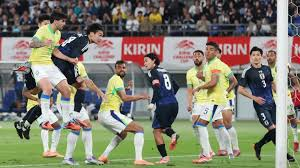
First Half: Japan’s Master Class in Defensive Discipline — and One Moment of Brilliance
From the first whistle, Japan executed their game plan to near-perfection. They sat deep, maintained their shape in two well-organised banks of four, and dared Brazil to break them down. It was a strategy rooted in pragmatism, but also in the knowledge that Brazil’s midfield — anchored by a Casemiro who had already struggled at times in the group stage — could be vulnerable when exposed in transition.
Brazil, for their part, looked sluggish and uninspired. They controlled possession in the way that top sides always do against a team that willingly cedes the ball, but they struggled to manufacture genuine openings. A Bruno Guimarães shot deflected harmlessly behind for a corner. Matheus Cunha had an effort pushed wide by the impressive Zion Suzuki. Long-range attempts from Vinicius and Cunha went nowhere near the target. Brazil weren’t just being denied — they were being stifled.
Then came the moment that changed everything.
On 29 minutes, Danilo gave the ball away carelessly on halfway — a loose, inexplicable pass that handed possession directly to Kaishu Sano. The Mainz midfielder didn’t hesitate. He took one touch, looked up, and drove at Casemiro, who was badly positioned and unable to recover. Sano powered into the penalty area and, with composure that belied the magnitude of the moment, buried a low shot past Alisson Becker. Japan 1, Brazil 0.
NRG Stadium went very nearly silent — save for the red-shirted pocket of Japanese supporters who erupted as one. On the sideline, Ancelotti’s expression betrayed nothing. In the stands, the nervousness was palpable.
Brazil were rocked. Their response in the remaining 15 minutes of the first half was tepid at best — a couple of aimless crosses, a half-hearted free-kick, nothing that seriously tested Suzuki. Japan, by contrast, looked comfortable, organised, and genuinely capable of holding their lead. At the half-time whistle, there was a very real sense that the unthinkable might be happening in Houston.
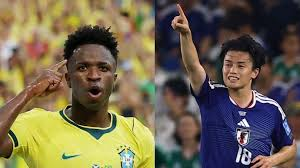
Half Time: Ancelotti Rips Up the Script
The details of what was said in the Brazil dressing room in those 15 minutes may never be fully known, but the effect was immediate and transformative. Brazil came out for the second half with a different tempo, a different intensity, and a different purpose. Ancelotti had clearly demanded more direct, aggressive play — and his players responded.
Within minutes of the restart, Guimarães was testing Suzuki with a forceful header that required a sharp low save. Then, on 53 minutes, came the moment that should have levelled the tie: Casemiro arrived unmarked at the far post and powered a header goalward — only for Takehiro Tomiyasu, in an extraordinary piece of defending, to clear the ball off the line. Casemiro could barely believe it. Japan had survived again.
But Casemiro — who had endured such a difficult first half, pilloried for his positioning before Sano’s goal — was not done. Three minutes later, on 56 minutes, a cross whipped in from the right by Gabriel found the midfielder rising at the back post. This time there was no defender on the line. This time the header was firm, accurate, and beyond Suzuki. Brazil 1, Japan 1.
The equaliser transformed the contest. Japan, who had been so controlled, suddenly found themselves scrambling. Brazil sensed blood. Vinicius Jr began to drift into dangerous positions, pulling at Takehiro Tomiyasu’s concentration with every run. Ancelotti sent on Endrick — the teenage Real Madrid prodigy who had become a cause célèbre among Brazil’s fanbase — to add a different dimension to the attack.
The Final Stretch: Drama, Heroics, and a Winner in the Shadows of Extra Time
The final 35 minutes were an extraordinary spectacle. Japan regrouped admirably after conceding — their defensive organisation, which had been so impressive in the first half, clicked back into place as they sought to keep Brazil at arm’s length and force extra time.
But the momentum was undeniably with the five-time champions. Vinicius Jr produced the moment of the match on 82 minutes: weaving through Japan’s backline with a combination of pace and skill that left multiple defenders trailing, before flicking a shot goalward that seemed destined for the net. Zion Suzuki flung himself to his right and somehow got a hand to it, deflecting it onto the post. It was a stop of the very highest order — the kind of save that defines goalkeepers at tournaments.
Endrick ran and ran, clever and direct, but Japan’s backline — led magnificently by Tomiyasu — continued to repel every threat. Into stoppage time: five minutes signalled, then six. The clock ticked. Extra time loomed.
Then Bruno Guimarães received the ball 25 yards out, drew a Japan defender with a shimmy, and slid a perfectly weighted pass into the path of substitute Gabriel Martinelli, who had come on in the 66th minute. Martinelli had one thought. He opened his body, took one touch, and rolled the ball low and across Suzuki into the bottom corner. The net rippled. The stadium erupted.
Brazil 2, Japan 1. Ninety-six minutes on the clock.
The Statistics Tell the Story
The xG numbers — Brazil 1.72, Japan 0.23 — offer a window into exactly how the match unfolded. Brazil dominated in territory and chances created; Japan were clinical, disciplined, and dangerous in only the most controlled bursts. It was the kind of defensive performance that makes a tournament run feel possible — and, in the end, it was the margin between the two sides that proved decisive only in the cruellest way.
Suzuki made seven saves in total, at least three of them genuinely exceptional. Casemiro, despite his contribution to the goal conceded, responded with a crucial equaliser. Martinelli, a substitute, was the hero. Guimarães, the assist-maker, was consistently Brazil’s most intelligent performer.
For Japan, Sano’s strike will be remembered. Tomiyasu’s goal-line clearance was the moment that may haunt them longest — a matter of inches that, had the ball gone in, might have seen Japan hold on and rewrite their knockout history entirely.
Player Ratings
Brazil
- Alisson — 7/10. Beaten by a superb Sano strike but otherwise commanding, distributing well and dealing confidently with Japan’s limited threat.
- Danilo — 5/10. A poor game capped by the loose pass that led to Japan’s goal. Lucky to stay on for the full 90.
- Marquinhos — 7/10. Solid, assured, never flustered.
- Gabriel Magalhães — 7/10. Excellent alongside Marquinhos, winning virtually every aerial duel.
- Vinicius Jr — 7/10. Increasingly dangerous as the match wore on. Denied a spectacular goal by a wonderful Suzuki save.
- Casemiro — 6/10. Dreadful in the first half, redeemed by his second-half equaliser. Carried an injury and was replaced late.
- Bruno Guimarães — 8/10. Brazil’s best player for the full 90 minutes. Controlled, intelligent, and delivered the crucial assist.
- Matheus Cunha — 6/10. Worked hard but ineffective in the final third.
- Gabriel — 7/10. Provided the cross for Casemiro’s equaliser and offered real width.
- Endrick — 6/10. Busy and direct, but Japan’s defence was equal to everything he attempted.
- Gabriel Martinelli (sub) — 9/10. Came on, changed the game’s energy, and delivered the moment of the tournament so far for Brazil’s fans.
Japan
- Zion Suzuki — 9/10. Exceptional. Denied Vinicius with a world-class save and made several crucial stops to keep Japan in the contest.
- Takehiro Tomiyasu — 9/10. Outstanding. His goal-line clearance may be Japan’s defining moment of the tournament. Handled Vinicius with rare authority.
- Kaishu Sano — 8/10. The goal was breathtaking. Composed, direct, and influential throughout.
- Daizen Maeda — 6/10. Japan’s pressing leader but starved of service in the second half.
What It Means: Brazil, Japan, and What Comes Next
For Brazil, this was a warning as much as it was a victory. The group stage comforts of big wins over Haiti and Scotland masked fragilities that Japan — organised, disciplined, and brave — exposed with forensic efficiency. Ancelotti will know that a Casemiro playing at the level seen in the first half will not be enough to beat the teams that lie ahead. Vinicius Jr, when he clicks into top gear, remains the most dangerous player at this tournament. The challenge now is ensuring the full team, not just the star names, fires together.
They will face the winner of Côte d’Ivoire vs. Norway in the Round of 16 on 5 July at MetLife Stadium in East Rutherford, New Jersey. Neither will be straightforward. Neither will accept the role of passive opponent.
For Japan, the exit stings. They played a courageous, disciplined game and were, for long periods, the better organised side. In Sano, Suzuki, and Tomiyasu, they boasted outstanding individual performers. But the failure to add a second goal — to punish Brazil’s sloppiness and make the mathematics insurmountable — ultimately proved fatal. The Samurai Blue’s knockout record remains one of world football’s most persistent anomalies. They will return to this tournament with plenty to build on.
Final Verdict
This was not Brazil at their majestic best. It was Brazil at their stubborn, sometimes beautiful, occasionally maddening worst — and then, at the very last, at their most clinically decisive. Martinelli’s winner was a reminder of what this squad can do when it reaches into its deepest reserves. Whether that will be enough to go all the way to the final remains very much an open question.
Japan left Houston with no winner’s medal, but with something arguably more meaningful: the respect of everyone who watched. They pushed the five-time world champions to the last kick of stoppage time. On another day — had Tomiyasu’s clearance gone the wrong way, had Sano not been caught in transition — they might have made history.
The World Cup continues. The drama has only just begun.
Brazil advance to the Round of 16 and face the winner of Côte d’Ivoire vs. Norway on 5 July 2026 at MetLife Stadium, East Rutherford, New Jersey.
Match report | FIFA World Cup 2026 | Round of 32
Now I have enough detail to write a comprehensive blog post. Let me create it as a well-formatted artifact. Fresh off the final whistle, here’s the full story from Houston:
Brazil came from a goal down at halftime to beat Japan 2–1 in a thrilling World Cup Round of 32 tie at NRG Stadium.
The second half told a completely different story. Casemiro had an agonising near-miss when he planted a header against Tomiyasu on the line, before making no mistake on 56 minutes — heading firmly past Suzuki at the back post from a Gabriel cross.
With extra time looming, it was Bruno Guimarães who found Martinelli deep into stoppage time, and the substitute finished low to seal a gut-wrenching tournament exit for Japan.
It was harsh on an obstinate Japan side who were chasing their country’s first World Cup knockout win, but Brazil finished strongly after a lethargic first-half display.
Brazil will now face the winner of Côte d’Ivoire vs. Norway in the Round of 16 on 5 July at New York New Jersey Stadium.





Leave a Reply