
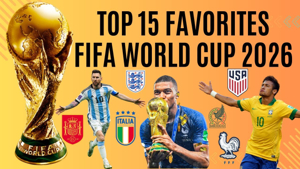
The 2026 FIFA World Cup, a historic 48‑team tournament hosted across the USA, Mexico, and Canada—promises more drama, upsets, and global spectacle than ever. With the expanded format favoring depth over one‑game magic, the usual suspects remain front‑runners, but the pecking order has shifted since the last World Cup.worldcuptrackers+3
Below is a ranked look at the top 10 favorites to lift the trophy in 2026, based on form, squad depth, tournament pedigree, and recent power‑ranking analyses from major outlets.sofascore+2

1. Spain – The Team to Beat
Spain tops many 2026 favorites lists, with several analysts labeling them the outright betting favorites. A blend of technical midfield control, high‑pressing systems, and a wave of young, big‑club talent (Real Madrid, Barcelona, etc.) has made La Roja the most balanced side in Europe.x+3
Spain’s strengths lie in their discipline, ball‑retention, and ability to grind out tight knockout games. Their main questions are mental toughness in finals and how they handle the pressure of being the clear favorite once the tournament starts.sports.yahoo+2
2. France – The Most Complete Squad
France has long been a World Cup powerhouse, and 2026 is no different. With Kylian Mbappé still in his prime and a remarkable depth of talent across attack, midfield, and defense, Didier Deschamps’ side is arguably the most physically and technically complete team on the planet.worldcuptrackers+1
Their strength is big‑game experience; they’ve reached multiple recent finals and know how to navigate knockout‑stage nerves. However, inconsistency in certain tournaments and occasional defensive lapses can leave them vulnerable to a top‑class counter‑attacking side.sports.yahoo+1
3. Argentina – Defending Champions, Still Dangerous
As reigning World Cup holders, Argentina enter 2026 with immense confidence and a winning mentality. Lionel Messi may be closer to the end of his international career, but players like Julián Álvarez, Enzo Fernández, and others have helped the team evolve into a more system‑driven unit.bbc+2
Their cohesion, set‑piece execution, and resilience under pressure make them a nightmare for opponents in the elimination rounds. The big concern is generational transition: if key veterans fade too quickly, the squad may lose some of its emotional spine.bbc+1
4. Brazil – Football Royalty With Firepower
Brazil remains every‑tournament favorite until proven otherwise. With attackers like Vinícius Júnior, Raphinha, and Rodrygo, plus a pipeline of talent from South America’s biggest clubs, the Seleção can dominate games when at their best.facebook+2
Their problem has often been defensive fragility and inconsistency in big matches, especially away from home. If Brazil can sharpen their shape and discipline, they are fully capable of reaching the final again in 2026.goal+2
5. England – Time to Deliver
England has carried one of the strongest squads in the world for years, anchored by Harry Kane before he finally stepped back from the national team. A new generation of attackers, midfielders, and defenders now gives England the balance they lacked in previous tournaments.goal+2
The Three Lions’ biggest hurdle remains converting dominance into titles. If they avoid the mental slip‑ups of past campaigns and solidify their defensive structure, England could very well break the “almost” cycle in the expanded 2026 format.worldcuptrackers+2
6. Portugal – Transitions With Stars
Portugal benefits from a smooth transition between generations. While Cristiano Ronaldo’s era is winding down, the emergence of players like Cristiano’s heir apparents at the top level keeps the squad competitive across all positions.facebook+2
Squad depth in midfield and on the wings, combined with a solid defensive core, makes Portugal a consistent threat in knockouts. Their main limitation is moments of inconsistency against fellow heavyweights, which can cost them in the semifinals or final.sofascore+2
7. Germany – Revamped, But Still Elite
Germany has quietly rebuilt after a few disappointing cycles. A new wave of Bundesliga stars, plus experience in international tournaments, has given Die Mannschaft both tactical flexibility and physical intensity.facebook+2
Their hallmark remains control through the middle of the park and a willingness to adapt formations mid‑game. With a few more consistent performances in major tournaments, Germany could easily barge into the top tier of 2026 favorites.sports.yahoo+2
8. Netherlands – Tactical Versatility
The Netherlands remain a perennial threat thanks to their manager‑led tactical adaptability and strong attacking options. With a mix of Eredivisie and top‑league talent, they can switch between pressing systems and more conservative setups depending on the opponent.goal+2
Their downside is occasional softness in key moments, especially when favorites or when draws protect seeding. If they can toughen up mentally and defensively, De Oranje are a serious semifinal‑caliber side.worldcuptrackers+1
9. Norway – Rising European Contender
Norway has emerged as an unexpected but increasingly credible contender, with several analysts slotting them near the top‑10 favorites. Erling Haaland remains the centerpiece—a world‑class finisher who can single‑handedly tilt knockout games.si+2
Beneath Haaland, Norway has improved their midfield balance and defensive organization, giving them more longevity in tournaments. Their main barrier is competition from more experienced European powers and the need to prove consistency over multiple knockout rounds.si+2
10. Colombia – Dark Horse With Flair
Colombia rounds out many top‑10 favorites lists as the leading “dark‑horse” team. When operating at their best, Los Cafeteros mix creativity, speed, and technical flair in a way that can unsettle even the strongest defenses.x+3
Their challenge lies in defensive solidity and maintaining discipline under pressure. If they fine‑tune their defensive structure and avoid early‑round slip‑ups, Colombia could surprise a higher‑seeded favorite and make a deep run.si+2
A Quick Snapshot: Top 10 Favorites Table
| Rank | Team | Key Strengths | Main Concerns |
|---|---|---|---|
| 1 | Spain | Technical control, cohesion, depth x+1 | Pressure as favorites, mental edge in finals worldcuptrackers+1 |
| 2 | France | World‑class attack, squad depth worldcuptrackers+1 | Knockout inconsistency, injuries worldcuptrackers+1 |
| 3 | Argentina | Winning mentality, system cohesion worldcuptrackers+1 | Aging core, post‑Messi transition worldcuptrackers |
| 4 | Brazil | Electric attack, global talent worldcuptrackers+1 | Defensive lapses, mentality worldcuptrackers+1 |
| 5 | England | Balanced squad, strong TS worldcuptrackers+1 | Turning finals into titles worldcuptrackers+1 |
| 6 | Portugal | Transitioning generations, depth worldcuptrackers+1 | Big‑game inconsistency worldcuptrackers+1 |
| 7 | Germany | Tactical flexibility, Bundesliga core worldcuptrackers+1 | Recent underperformance worldcuptrackers+1 |
| 8 | Netherlands | Tactical adaptability, attacking options worldcuptrackers+1 | Key‑moment fragility worldcuptrackers |
| 9 | Norway | Haaland, improving structure x+1 | Inexperience vs top teams si+1 |
| 10 | Colombia | Flair, creativity, fast transitions si+1 | Defensive discipline si+1 |
Final Thoughts: Who’s Truly the Favorite?
Across several recent power rankings and betting‑market analyses, Spain, France, Argentina, and Brazil consistently occupy the top spots, with England and Portugal not far behind. Given the expanded format and the physical toll of multiple knockout games, the ultimate winner will likely be the team that combines tactical intelligence, squad depth, and mental toughness.sofascore+2
If you had to pick one: current models lean toward France or Spain as the most likely champions, but Argentina’s winning culture and Brazil’s attacking firepower ensure that no clear “obvious” winner will emerge until the final whistle on the pitch.sofascore+2






Leave a Reply